
December 15, 2025
CHRISTMAS LIGHTS
The 103rd National Christmas Tree Lighting Ceremony occurred on December 4 this year in Washington, DC on the Ellipse near The White House. Over 60,000 lights cover the 35-foot-tall red spruce tree. The event was sponsored by GE Lighting, who not only created the first National Christmas Tree Lighting Ceremony, but were single-handedly responsible for making decorating with Christmas lights a tradition.
As a way to promote his newly invented electric lights, Thomas Edison hung strands of lights outside his laboratory during the 1880 Christmas season. Thousands of people came to see the display, and railroad passengers could see the lights as their train passed through Menlo Park. Two years later, Edison's business associate, Edward Johnson, hand-wired electric lights around a tree on a rotating pedestal in his large front window. Newspapers covered the story of the spectacle, and again people gathered to see the first electric Christmas tree.
But very few homes had electricity, and even fewer people could afford electric lights, especially for something as frivolous and temporary as Christmas decorations. By 1920, only 35% of American homes had electricity. General Electric wanted to change that. In 1923, Frederick Feiker, a member of Calvin Coolidge's administration, a leader in the Society for Electrical Development, and former marketer for General Electric, had an idea about how to promote electricity to the country. He proposed creating a National Christmas Tree, believing it would encourage regular Americans to decorate their homes with Christmas lights. So on December 24, 1923, President Calvin Coolidge presided over the inaugural National Christmas Tree Lighting Ceremony.
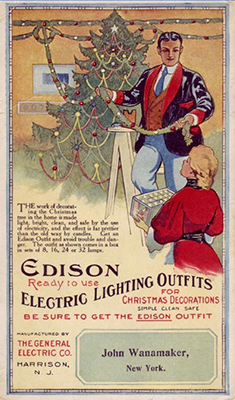
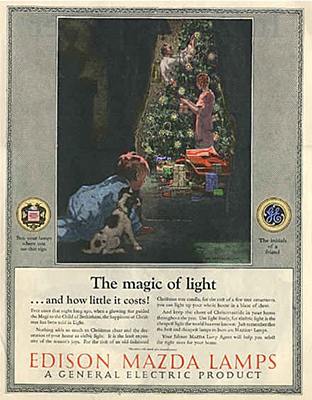
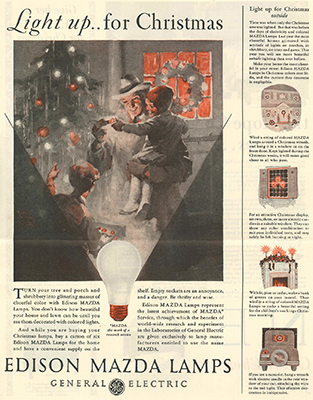
And then General Electric went to work. Over the next decade, while electricity was slowly spreading across the country, General Electric launched an aggressive marketing campaign convincing the country that bright, electric lights were the perfect way to create a festive display for Christmas. As the Great Depression began wearing down the American spirit, and electricity became more commonplace and inexpensive, bright holiday lights seemed very appealing as a brilliant sign of hope.
The National Christmas Tree became a tradition, but more importantly, it changed the landscape of the country. By 1930, almost 70% of American homes had electricity. Between 1935 and 1936, General Electric's sales of Christmas lights increased 59%. By the 1950s, Christmas lights had become a regular holiday fixture in most American cities and homes.
This year, sales of Christmas lights in the United States will exceed $20 billion. Whether you enjoy decorating your own house or simply watching the newest season of The Great Christmas Light Fight, remember that none of it would be part of our Christmas traditions if it weren't for General Electric's determination to make the holidays merry and bright.
SOURCES
- "History of the National Christmas Tree" from the National Park Service
- "From Thomas Edison to LEDs: A Brief History of Christmas Tree Lights" from Mental Floss
- "Student Research: The History of Christmas Lights" from Claremont Graduate University
- "The Electricity Lobby Was Behind the First National Christmas Tree Lighting" from Time
- "The 2025 Christmas Lighting Market Exceeds $20 Billion: Smart Technology And Sustainability Become Core Growth Engines" from Bright Max
- All images are public domain
LISTEN

SUBSCRIBE


