
February 18, 2026
GROUNDHOG DAY
Earlier this month, less than 200 miles from Pulsar's offices in York, Pennsylvania, an annual tradition was carried out in Punxsutawney. This small, Pennsylvania town becomes the focus of the whole world every year on the second day of February. A group of bearded men in top hats lifted a plump groundhog from its stump, held it high for the crowd to see, and declared that there will be six more weeks of winter. It's a quirky and antiquated ritual that occurs in an obscure, little town. There appears to be no reason for its widespread recognition and popularity, until you realize the entire thing is a masterclass in marketing.
Groundhog Day derives its origins from a Catholic feast day known in Medieval Europe as Candlemas. The holiday celebrates the presentation of the baby Jesus at the temple, but it usually marked the official end of the Christmas season. Worshippers would bring their candles to the church to be blessed for the rest of the year. Along with looking ahead to the coming year, the day also happened to fall exactly midway between the winter solstice and the spring equinox. That led to the day being seen as an omen for the severity of winter and the approach of spring. In Germany especially, legends arose about hibernating animals emerging from their dens on Candlemas to predict the arrival of warmer weather. Originally, the sacred animal was a bear, but as bears grew scarcer, the Germans settled on the badger as their prognosticator.
When German immigrants settled in the New World, specifically Pennsylvania, they brought the legend of the badger with them. In southern Pennsylvania, however, they found the peculiar American marmot to be far more abundant, and chose that similar animal as the new forecaster. The burrowing marmot was known as a "ground badger" (grundachs) in German. English settlers in southern Pennsylvania used the term "ground pig," which was translated by German settlers in Pennsylvania's York County as grundsau, or "ground sow." That word was the origin of the term "groundhog," which was only used in Pennsylvania Dutch counties until the late 1800s.
In 1886, Clymer Freas, the editor of the Punxsutawney Spirit newspaper, decided to use the power of the press to market the city of Punxsutawney. He capitalized on the unique tradition of observing the groundhog's shadow as a means to predict the weather, and formally renamed the Punxsutawney Elk's Lodge the "Groundhog Club," and proclaimed Punxsutawney the "Weather Capital of the World." With a group of men christened to carry out the annual pageantry, Freas published the first Groundhog Day prediction in 1887. By 1904, the Punxsutawney Spirit's prediction was being reprinted in larger market newspapers like the New York Telegraph and the Washington Post, and was drawing a large crowd of visitors from across Pennsylvania. In 1909, the Punxsutawney Groundhog Club made trips to New York City and the World Series in Pittsburgh to promote their city and increase interest in tourism and business.
In 1953, Punxsutawney sent two baby groundhogs to the Griffith Park Zoo in Los Angeles. The groundhogs were named after the new royal family in England, Elizabeth and Philip. The gift was never received because the California Department of Agriculture declared the rodents "pests" and destroyed them. The incident led to the next branding development for the groundhog, his name officially becoming Punxsutawney Phil. According to the Groundhog Club, Phil is immortal and has been the same groundhog since 1887, despite the fact that groundhogs tend to live about five years.
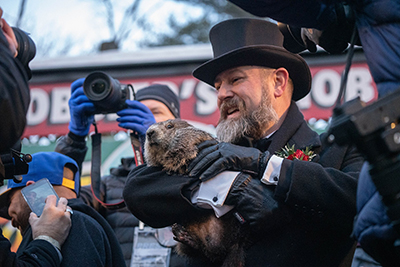
Punxsutawney Phil on Groundhog Day 2022. Photo by Anthony Quintano.
Punxsutawney averaged 4000 visitors for its Groundhog Day celebration throughout the 20th century, but it received another marketing boost in 1993. That year, Columbia Pictures released the movie Groundhog Day. Danny Rubin, the writer of the film, chose Groundhog Day as the date and Punxsutawney as the setting because he felt most Americans were only vaguely familiar with the holiday and not at all familiar with the town. That may have been true at the time, but not any more. The movie grossed $71 million and became the tenth most popular movie of 1993. After the film, the annual crowds grew tenfold. This year, over 30,000 people gathered to see Punxsutawney Phil, even though the temperature was below freezing.
An interesting footnote to this entire holiday is a recent discovery made by a biology professor at Pennsylvania State University. It turns out the groundhogs are not emerging from their holes to check the weather; they're scoping out potential mates. Male groundhogs will visit several female dens during early February, sleep for the rest of the winter, then return to their chosen mate in late March. So while we're marketing their behavior as a forecast for us humans, they're just doing what animals have done for millennia, keeping their species alive year after year after year.
SOURCES
- "Ground Hog History" from The National Weather Service
- Pennsylvania Dutch: A Dialect of South German with an Infusion of English by Samuel Stehman Haldeman
- "The Surprising History of Groundhog Day" from The Franklin Institute
- "Totemism and Civic Boosterism in Punxsutawney, Pennsylvania, 1899-1909 from The Western Pennsylvania Historical Magazine
- "Why is Punxsutawney's Groundhog Called Phil?" from Mental Floss
- "Eight Things to Know about Groundhog Day and Its Big Star, Punxsutawney Phil" from NPR
- "How I Wrote the Script for Groundhog Day in Less than a Week" from The Telegraph
- "The Year in Movies: '93 a Record-Smasher at the Box Office" from the Los Angeles Times
- "Thousands of Fans Go Wild for Punxsutawney Phil" from The Cincinnati Enquirer
- "The Truth about Groundhog Day" from the National Wildlife Foundation
LISTEN

SUBSCRIBE


