
May 14, 2026
THE OSCARS
We are officially in the midst of awards season, which is a ridiculous statement because entertainment prizes are awarded all year long. There are at least 19 televised award shows scheduled for this year. In 2025, the top seven award shows yielded a combined audience of over 75 million viewers. There are now awards for nearly every aspect of the entertainment complex, including sports, which already have awards for winning their respective competitions. The entire world is clearly obsessed with awards, and often ascribes greater value to those things which have been awarded. That mentality and behavior is no accident. It was carefully cultivated by marketers over nearly 100 years. And it all began with one controlling movie mogul in 1929.
In some ways, Hollywood had reached its pinnacle in the 1920s. A handful of movie studios controlled every aspect of production, distribution, and exhibition, and were making massive profits. But the industry was also facing huge challenges. As the movies were transitioning from silent to sound, scandals involving drugs, drinking, rape, and murder filled newspapers across the country. Murmurs of disgruntled movie employees and unions were beginning to circulate. Something needed to be done to ensure the money would keep pouring into Hollywood and the studio control could be maintained.
Enter Louis B. Mayer, the head of MGM. In an effort to stave off unions and consolidate studio power, he formed the Academy of Motion Picture Arts and Sciences, and with it, the idea of official movie awards. His intentions were captured in his own words: "I found that the best way to handle them was to hang medals all over them. If I got them cups and awards they'd kill themselves to produce what I wanted. That's why the Academy Award was created."
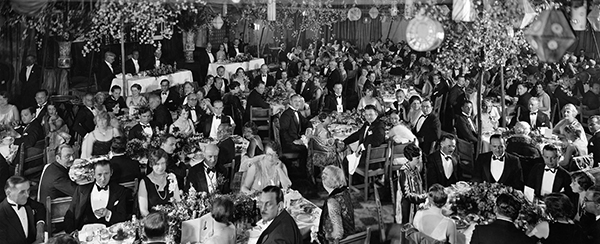
The First Annual Academy Awards Presentations by the Academy of Motion Picture Arts and Sciences, May 16, 1929.
So ultimately, it was a marketing show designed to appease/distract actors, writers, and directors from the absolute control the movie studios wielded. And it worked brilliantly. The first Academy Awards presentation was held on May 16, 1929, at the Hollywood Roosevelt Hotel with a dinner for 270 guests. Nineteen golden statuettes were presented. And two other marketing objectives were soon realized. In addition to stroking Hollywood egos, the awards captured the imagination of the entire country, and began to improve public perception of the movies. The awards also added perceived credibility to winning films, and added extra marketing promotion for nominated movies.
All future Academy Award presentations were broadcast to the public, first on radio, then on television. In 1935, the same Louis B. Mayer ran the first advertisement suggesting that one of his films, Ah, Wilderness, should be nominated for the award that he had created. It didn't work because the film was not nominated, but it did work because it created the marketing engine that continues to drive all award shows to this day.
Oscar campaigns rapidly became bigger and bolder. In 1955, United Artists spent $50,000 more than the entire production budget to promote the film Marty for the Academy Awards. The notorious Harvey Weinstein surpassed everyone's expectations in 1999 when he mounted a successful campaign that led to smaller, less popular Shakespeare in Love defeating Saving Private Ryan for best picture.
Oscar campaigns today typically extend into millions of dollars, and still sometimes exceed production costs, like when Netflix spent $40 million to get an Oscar nomination for $15-million-film Roma. We've looked at Hollywood accounting before, but this is another instance of movie studios spending ridiculous sums of money for perceived value in an arbitrary award. But there is some evidence that the value is more than perceived. On average, movies nominated for an Academy Award receive a 22% boost, resulting in an average $16.5 million increase in revenue.
But the greatest legacy of the Academy Awards may be the effect they have had on entertainment in general and all of us specifically. In 1940, RKO ran the first successful Oscar campaign that resulted in Ginger Rogers receiving the Best Actress Academy Award. Within the next 14 years, the Golden Globes, Tonys, Emmys, and Grammys were established, all taking their cues from the Academy Awards.
Glitzy outfits, ostentatious productions, dramatic surprises, provocative speeches: these familiar features ignite our imaginations and drive our conversations. Award shows have always been, and continue to be, an advertisement for glamor, cultural influence, creative endeavors, and the arts themselves. And the fact that we not only continue to watch them, but discuss the results and believe they represent value, indicates that we accept Louis B. Mayer's original intention. Awards not only encourage celebrities to keep playing the game; they encourage us to do the same.
SOURCES
- "Guide to Awards Show Season 2025-26: How to Watch Live" from DIRECTV
- "Awards Show Ratings Reveal Signs of Life Post-pandemic, but the Glory Days May Be Over" from Yahoo Entertainment
- "The Nightmarish Underside of the Dream Factory: How Babylon Captures Hollywood in the 1920s" from The Conversation
- "How the Oscars Got Started - and All the Flops that Almost Did It In" from the New York Post
- "The First Academy Awards" from the Academy of Motion Picture Arts and Sciences
- "For Your Consideration" from CBC Radio
- "Shakespeare in Love Reinvented Oscar Campaigning in 1998" from The Hollywood Reporter
- "How Hollywood Turned the Oscars Into a $500 Million Marketing Machine" from Media Shower
- "Oscar Nominations Often Lead to Boost in Movie Revenues" from The Boston Globe
- "The Oscars Are Obviously an Advertisement and That's Okay" from Medium
- All images are public domain
LISTEN

SUBSCRIBE


