
September 17, 2025
WRIGLEY
Imagine this scenario. You receive a sales flyer in the mail that highlights several deals at your local grocery store. Realizing you need some of those items, you go to the store to pick up a few things. At the checkout, you see some gum and candy, and grab a few of those. Then your items are scanned and quickly bagged, and you're on your way in a matter of minutes. This sequence of activities is played out millions of times every day all over the world. And every one of them was invented by one man who was trying to sell chewing gum to you.
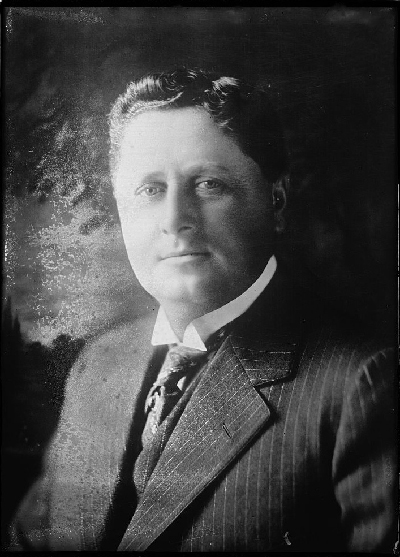
William Wrigley, Jr. began his career selling soap for his father. In 1891, he moved to Chicago to start his own soap business. He began offering a free can of baking soda with every soap sale, and he soon realized that baking soda was more popular than his soap, so he switched to selling baking soda. He chose to offer another free incentive with this product; this time it was chewing gum. Again, he found that his customers wanted chewing gum more than baking soda, so he pivoted again. In 1893, he created his first two brands - Wrigley's Spearmint and Juicy Fruit - which are still available today.
Wrigley then went on to pioneer a number of marketing strategies. In 1915, he invented direct mail marketing by using recently-published telephone books, which now contained full residential addresses, and mailing two sticks of chewing gum to every address in the country. Within ten years of this campaign, Wrigley's sales grew sevenfold to $7 million annually.
He also designed various tin boxes and baskets for his gum that he distributed to restaurants and shops to place near their cash registers, essentially inventing what is now known as impluse purchasing. In 1962, the Wrigley Company funded a Stanford Research Institute study to quantify the effects of impulse buying. The paper found that almost 51% of American supermarket purchases were unplanned, and the most likely location for those unplanned purchases to occur was the checkout stand.
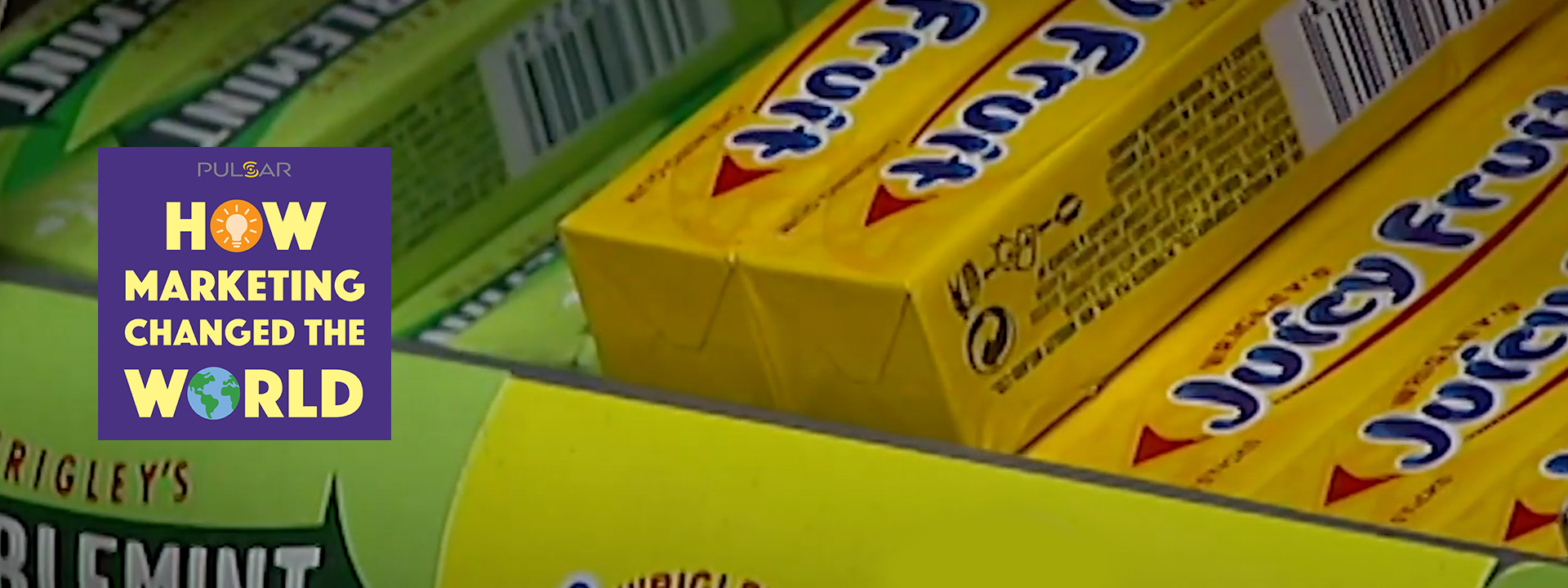
In 1974, at a supermarket in Troy, Ohio, Wrigley again made headlines when a pack of Juicy Fruit gum became the first product scanned with a new barcode named the Universal Product Code, the now ubiquitous UPC that identifies every retail product. Juicy Fruit was chosen due to its small size, believing that if the code could scan accurately at that size, it should work for every product.
William Wrigley, Jr. is often regarded as the father of modern advertising. "Tell 'em quick and tell 'em often," was his mantra that drove all of his ideas and innovations. He changed the entire advertising landscape, and created strategies and solutions that are still used every day. There aren't many checkout stations in the world that still don't have a display of Wrigley gum. According to market research, in 2021 shoppers spent a total of $6 billion just in the checkout area.
SOURCES
- "Vintage Advertising: Chew on This!" fromThe Saturday Evening Post
- "William Wrigley Jr.’s Legacy for Entrepreneurs" from Golden Vision Training
- "Historical Chicago Directories: More Exciting Than Reading the Phone Book" from the Chicago Public Library
- "The Mastermind of the Impulse Buy" from Shoddy Goods
- "Juicy Fruit Gum Tin" from National Museum of American History
- "Supermarket Scanner" from National Museum of American History
- "Why Stores Always Put Candy and Soda Near the Cash Register" from CNN
- All images are public domain
LISTEN

SUBSCRIBE


